
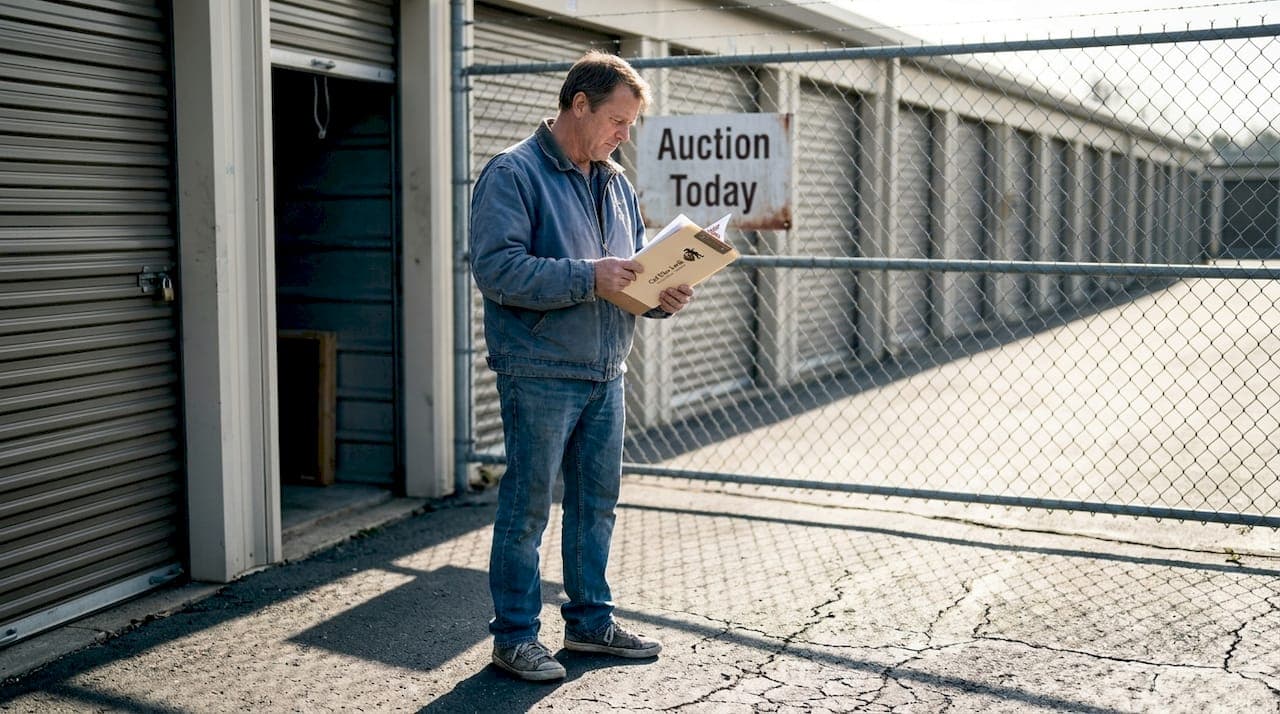
Most people assume that when a storage unit gets abandoned, everything inside ends up at the dump. That's not how it works. Storage facilities are legally required to follow a formal process before selling a single item, and those contents are auctioned off, not thrown away. Whether you're a bargain hunter looking to score interesting finds, or a former tenant who lost access to irreplaceable belongings, the system offers more options than you might think. This guide walks you through every stage of abandoned storage resale, from the legal mechanics to practical steps for buyers and people trying to get their things back.
Table of Contents
- What is abandoned storage resale?
- How storage auctions work: From loss to resale
- Who participates and benefits: Buyers, tenants, and storage facilities
- Practical tips for buyers and former tenants
- The overlooked truth: Community impact and hidden emotional value
- Ready to take the next step? Find, recover, or buy with Cut The Lock
- Frequently asked questions
Key Takeaways
| Point | Details |
|---|---|
| Legal auction process | Storage resale follows a regulated process, with notices and waiting periods set by law. |
| Recovery opportunity | Former tenants can sometimes reclaim items or surplus funds if they act quickly. |
| Buyer benefits | Auction buyers gain access to unique finds while helping recover unpaid rent for facilities. |
| Community impact | Storage resale can return lost memories and support local connections beyond business. |
What is abandoned storage resale?
Abandoned storage resale sounds like a niche corner of the secondhand market, but it's actually a well-regulated legal process with roots in property and lien law. When a renter stops paying on a storage unit and stops responding to the facility, the facility doesn't simply clear everything out. Instead, it initiates a formal lien enforcement procedure, which is the legal mechanism that eventually allows those contents to be sold.
The key word here is legal. This is not a gray area. The lien enforcement process allows a sale to proceed only after renters have defaulted on rent and required notices are met. That means the renter must be notified, a waiting period must be observed, and the sale must typically be advertised publicly. In Kansas, for example, that waiting period runs approximately 45 days from the initial default before any auction can legally take place.
This process sets abandoned storage resale apart from a typical garage sale or thrift store drop-off in several important ways:
- Legal authority: The sale is backed by lien law, not just a discretionary decision by the facility owner.
- Transparency: Sales must be publicly advertised, which means buyers and former tenants can find out about them.
- Accountability: Proceeds are used first to cover unpaid rent, and any surplus must be handled according to statute.
- Documentation: The entire process creates a paper trail that can be useful for both buyers and former tenants.
"No one should lose their family photos, their parent's ashes, or their children's artwork just because they fell behind on a storage bill."
That's the human side of something that looks purely transactional on paper. You can read more about what happens after auction to understand the full lifecycle of these contents.
Here's a quick comparison to help clarify how this market differs from other resale channels:
| Feature | Abandoned storage resale | Thrift store | Garage sale |
|---|---|---|---|
| Legal authority | Yes, lien law backed | Donation based | Voluntary |
| Required notice | Yes | No | No |
| Buyer transparency | Publicly advertised | Walk-in | Word of mouth |
| Former tenant recourse | Yes, statutory | No | No |
| Surplus returned | Possible | N/A | N/A |
Understanding this structure is what separates smart participants from those who stumble in blind. The legal foundation isn't just a technicality. It's the framework that creates fairness, and sometimes, the pathway back to lost belongings.
How storage auctions work: From loss to resale
With the definition clear, let's see how the abandoned contents actually move from missed payments to auction block, and what that means for buyers and former tenants.
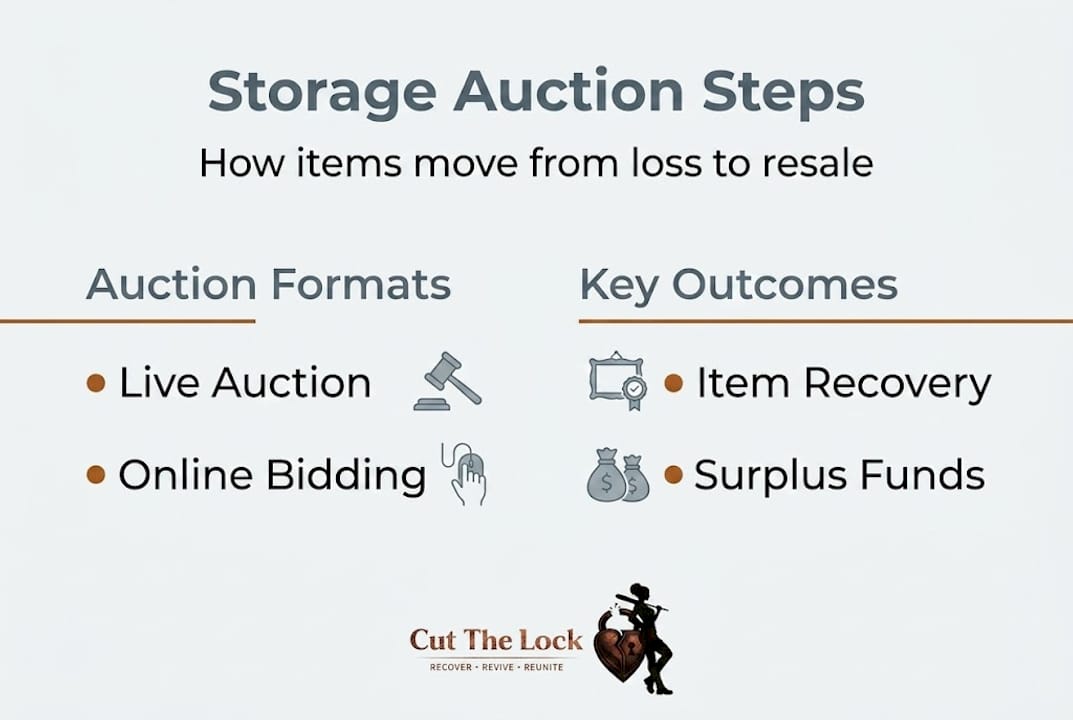
The timeline from a missed payment to an actual auction typically unfolds in several defined stages. Each stage carries legal weight, and skipping any step would invalidate the sale. Here's how it usually progresses:
- Missed payment: The renter fails to pay rent on the due date.
- Late notice: The facility sends a written notice of the overdue balance, usually by certified mail or per the rental agreement terms.
- Lien notice: A formal lien notice is sent, typically after a set grace period, warning of the intent to auction.
- Mandatory waiting period: Required notices and advertising must precede any auction, and surplus proceeds may be returned to the tenant.
- Public advertisement: The auction must be advertised, often in a local newspaper or on an approved online platform.
- Auction day: The unit contents are sold as a lot to the highest bidder, usually without the ability to inspect individual items closely beforehand.
- Proceeds applied: The facility uses sale proceeds to cover unpaid rent and related costs.
- Surplus handled: If the sale generates more than what is owed, the leftover funds are typically set aside for the former tenant to claim.
Storage auctions happen in two main formats today:
| Format | How it works | Best for |
|---|---|---|
| Live in-person | Buyers gather at the facility; unit door opens briefly for visual inspection; bidding starts | Experienced buyers who read units well |
| Online auction | Listings posted on platforms like StorageTreasures or Bid13; photos available; bidding happens remotely | New buyers or those in remote areas |
Online auctions have grown significantly, especially after the pandemic accelerated digital adoption across the storage industry. They allow wider participation and give former tenants a chance to spot their belongings and explore finding lost items after auction before contents are resold.

One often overlooked element is the surplus fund mechanism. If a unit sells for more than the debt owed, the extra money belongs to the former tenant, not the facility. Statutes in most states require the facility to hold that surplus and provide instructions for claiming it. If you're a former tenant, this is one of the options for former tenants worth pursuing immediately after an auction.
Pro Tip: Research your specific state's storage lien statutes before attending an auction or trying to recover items. Waiting periods, notice requirements, and advertising rules vary significantly between states, and knowing the rules in your area gives you a major advantage.
Who participates and benefits: Buyers, tenants, and storage facilities
Understanding the process leads naturally to the question: who gets involved, and what do they stand to gain or lose?
Three main groups show up in the abandoned storage resale world, and each has a different relationship with the auction outcome.
Buyers are the most visible participants. They show up on auction day (in person or online) hoping to score valuable contents at a fraction of retail value. Buyers range from:
- Casual thrifters looking for furniture, clothing, or household goods at low prices
- Resale entrepreneurs who flip items through eBay, Facebook Marketplace, or their own storefronts
- Collectors and hobbyists chasing specific categories like vintage electronics, tools, or antiques
- Treasure hunters drawn by the thrill of not knowing what's inside a unit
The appeal is real. A unit might contain an entire household's worth of goods purchased for a few hundred dollars. But buyers accept significant risk: they buy contents as-is, often without being able to touch or fully inspect items beforehand.
Former tenants are the group most people forget about. These are the people who stored their belongings in the first place, often during a difficult life transition like a move, a divorce, a job loss, or a health crisis. Their situation ranges from frustrating to heartbreaking. Some lose items they intended to retrieve; others had no idea the auction was happening. Under most state statutes, auction proceeds first pay back rent owed, with surplus handled separately, which means tenants rarely see money back but do have the legal right to claim any surplus funds.
Storage facilities are the third player. They initiate the process to legally recover unpaid rent and free up the unit for a new tenant. Compliance is critical for them. Failing to follow proper lien procedures can expose a facility to lawsuits, so most facilities follow the process carefully.
Pro Tip: If you're a former tenant, don't wait. Contact the facility immediately if you suspect your unit has been auctioned. Some facilities work with recovery services that catalog contents and can help you locate specific items before they're resold.
One underappreciated benefit of this ecosystem is the chance to find lost belongings through platforms that catalog auction contents. When a buyer or recovery service photographs and logs every item from a unit, former tenants have a real shot at reconnecting with belongings they thought were gone forever.
- Family photographs
- Legal and financial documents
- Children's artwork or keepsakes
- Urns and memorial items
- Handmade or heirloom jewelry
These items have no resale value to a buyer but enormous personal value to the person who owned them. That mismatch is exactly what makes catalog-based recovery services so important.
Practical tips for buyers and former tenants
Now that you know who participates, let's focus on concrete steps and tips to maximize your success as a buyer or a former tenant trying to reclaim items.
For buyers, success at storage auctions is part research, part instinct, and part discipline. Here's how to approach it the right way:
- Register in advance. Most online platforms and many live auctions require pre-registration with a valid ID and a deposit or bidding fee.
- Study the photos or unit carefully. Look for visible brand names, furniture quality, and signs of organized vs. chaotic packing. Organized packing usually signals more deliberate storage and potentially better contents.
- Set a hard budget. Overbidding is the most common mistake. Decide your maximum before bidding starts and stick to it, regardless of how exciting the unit looks.
- Factor in removal costs. Most auctions require you to clear the unit within 24 to 48 hours. Factor in truck rental, disposal fees, and labor before your bid.
- Research local laws. Notices, advertising, and surplus handling are governed by law. Understanding your state's rules can tell you whether an auction was legally conducted, which matters if a dispute arises.
- Start small. New buyers often overpay on first units. Start with lower-value units to build experience before competing on larger lots.
You can also browse auction items directly through catalogs that show individual items rather than whole units, which removes much of the guesswork.
For former tenants, the window to act is narrow but real:
- Contact the facility immediately. Ask whether the auction has occurred and when.
- Request surplus fund information. If the unit sold for more than owed, you have a legal claim to the difference.
- Search catalogs and listings. Platforms that photograph and itemize unit contents give you a searchable database to find your things.
- Check state-specific rules. Texas storage auction laws, for example, have specific requirements around notice and redemption periods that differ from other states.
- Document everything. Keep records of your storage agreement, payment history, and any communications with the facility. This documentation supports any legal claim or recovery effort.
Pro Tip: Document your storage unit contents with photos before you first rent, and update those photos annually. If you ever lose access unexpectedly, that photo record is invaluable for identifying and claiming your items later.
Common mistakes to avoid:
- Ignoring the legal timeline and assuming you have more time than you do
- Failing to claim surplus funds within the statutory deadline
- Not verifying that an auction platform is legitimate before bidding
- Assuming all contents are junk (buyers) or all contents are gone (tenants)
The overlooked truth: Community impact and hidden emotional value
Most guides about storage auctions focus entirely on the financial angle, what you can buy for cheap, how to flip units for profit, or how facilities recover debt. That framing misses something important.
Every storage unit tells a story. The contents represent someone's life at a specific moment, often a difficult one. A unit filled with baby clothes and photo albums belongs to a parent who hit a rough patch, not a hoarder who stopped caring. A unit full of tools and work gear might belong to someone whose business failed. These are real people, and the items inside carry real emotional weight.
We've seen buyers open units and immediately set aside photographs, letters, and memorial items because they recognized those things shouldn't be resold. That instinct is worth celebrating. When buyers take the time to surface sentimental items and connect them back to their original owners, the whole process becomes something more meaningful than a treasure hunt.
The mission at Cut The Lock is built on this insight. Catalogs don't just help buyers see what they're bidding on. They create a searchable bridge between lost belongings and the families who miss them. That's not just good business. It's a form of community care that rarely gets acknowledged in the broader conversation about storage auctions.
Ready to take the next step? Find, recover, or buy with Cut The Lock
Storage auctions are more than a bidding game. They're a system where lost things can find their way home, and where buyers can find genuine value in items that deserve a second life.

Cut The Lock buys abandoned storage units, photographs and catalogs every single item inside, and then works to reunite former tenants with belongings that matter most. Whatever is left gets listed in a curated online marketplace. If you're a former tenant trying to recover lost items or simply want to find lost belongings from a unit that was auctioned, start your search now. Buyers looking for unique finds can browse current listings too. You can also go directly to get your stuff back to start the recovery process today.
Frequently asked questions
Is it legal to buy items from abandoned storage units?
Yes, purchasing items from storage auctions is entirely legal as long as the facility followed proper legal process requirements, including required notices, waiting periods, and public advertising before the sale.
Can former tenants recover their lost items after auction?
It depends on timing and what was sold. Surplus handling is addressed in statutory language, meaning excess funds from the sale may be returned, but physical items may already be in a buyer's hands, making catalog-based recovery services the best option.
Where do I find upcoming storage auctions?
Check individual storage facility websites, auction platforms like StorageTreasures or Bid13, and local classified listings, as facilities are legally required to advertise sales publicly before they occur.
What if sentimental or important items are lost?
Contact the auction organizer or storage facility as quickly as possible, and search any available catalogs or listings. Items identified before resale can sometimes be retrieved, especially through platforms that photograph and itemize unit contents before selling them.