

Losing a storage unit to auction is one of those gut-punch moments that hits differently when the unit held more than furniture. Family photos, your grandmother's jewelry, your child's first drawings — gone in an afternoon bid. The panic that follows is real, and the confusion about what to do next makes it worse. But here's what most people don't realize: recovery is often possible, and in many cases, the law is on your side. This guide walks you through your legal rights, how to prepare your case, the exact steps to take, and what to do when things get complicated.
Table of Contents
- Understanding your rights after a storage auction
- Prepare before contacting the storage facility or buyer
- Step-by-step: How to recover your lost items
- Troubleshooting and special cases
- A different perspective on lost storage items: Lessons learned
- Need more help tracking down auctioned items?
- Frequently asked questions
Key Takeaways
| Point | Details |
|---|---|
| Know your rights | State laws and auction policies may let you recover personal items even after a sale. |
| Prepare evidence | Gather ownership documents, a list of lost belongings, and sentimental value proof before contacting the facility or buyer. |
| Act quickly | Many recovery options and legal remedies are time-sensitive and may expire within months. |
| Explore all options | Contact both the facility and auction buyer and use all reporting and support tools to improve your chances. |
Understanding your rights after a storage auction
Before you pick up the phone or drive to the facility, you need to understand what just happened legally. When a storage unit goes to auction, the facility exercises what's called a lien sale — a legal process that allows them to sell your belongings to recover unpaid rent. Once the sale closes, ownership of the contents generally transfers to the winning bidder. That transfer is real, and it matters.
But ownership of general contents doesn't always mean the buyer gets to keep everything without question. Buyers are often required to return sentimental or personal items like photos, documents, IDs, and birth certificates to the facility for the original owner. Whether this is enforced depends heavily on your state and the auction house's own rules.
Here's a rough breakdown of what's typically recoverable versus what usually isn't:
- Often recoverable: Family photos, personal documents (passports, birth certificates, Social Security cards), medical records, children's artwork, urns or cremated remains, military medals
- Rarely recoverable: Furniture, electronics, clothing, tools, collectibles, and anything with clear resale value
- Gray area: Jewelry, heirlooms, and items with sentimental value that also carry market value
State law plays a massive role here. States like California and New York have strict notice requirements before a lien sale can proceed. If the facility failed to follow those rules, you may have grounds to challenge the sale in court. However, buyers who purchased in good faith are typically protected even if the facility made procedural errors.
Military tenants get a separate layer of protection. Under the Servicemembers Civil Relief Act, military tenant protections can pause or restrict lien sales entirely during active duty. If you or a family member was on active service when the unit was auctioned, this is worth investigating immediately.
"If the sale was conducted without proper legal notice, you may have the right to challenge it — but act fast. Courts have strict deadlines, and delays can eliminate your options entirely."
Knowing where you stand legally is the foundation. Once you've assessed that, you can find your belongings and understand what happens after auction to set realistic expectations before making contact.
Prepare before contacting the storage facility or buyer
Reaching out unprepared is one of the most common mistakes people make. You'll get further — and faster — if you walk in with documentation and a clear story. Think of it like showing up to a job interview versus showing up and winging it. Preparation signals that you're serious and organized.
Start by gathering these essentials:
- A copy of your original storage lease or rental agreement
- A valid government-issued photo ID
- Any payment records or receipts (even partial payments)
- A written list of sentimental items you're trying to recover, with as much detail as possible
- Any photos or videos you have of the unit's contents
- Appraisals or receipts for high-value items
Use this preparation checklist to stay organized:
| Document | Why it matters | Where to get it |
|---|---|---|
| Storage lease | Proves your tenancy and unit number | Facility records or your email |
| Photo ID | Confirms your identity | Government-issued ID |
| Payment history | Shows partial or prior payments | Bank statements or receipts |
| Item list | Supports your recovery claim | Your own records or memory |
| Photos of contents | Visual proof of ownership | Phone, cloud storage, social media |
| Appraisals | Establishes value for legal claims | Jeweler, appraiser, or online records |
For sentimental items specifically, document the emotional context. Write down why something matters: who gave it to you, when, and what it represents. This won't have legal weight in court, but it can move people on a human level when you're speaking with a buyer or facility manager.
Also check whether auction proceeds exceeded your outstanding debt. If the sale generated more than what you owed, you may be entitled to surplus funds — with most states giving you 1 to 2 years to claim that money (New Mexico allows 2 years, Kansas allows 1 year).
Pro Tip: If you suspect the sale was illegal or that you weren't properly notified, do not wait. Consult a local attorney or your state's consumer protection office before making any contact. Anything you say to the facility could affect a future legal claim.
For a deeper breakdown of your options, the ways to find lost items guide can help you map out your next moves before you make a single call.
Step-by-step: How to recover your lost items
With your documents ready and your rights understood, here's exactly how to move forward.
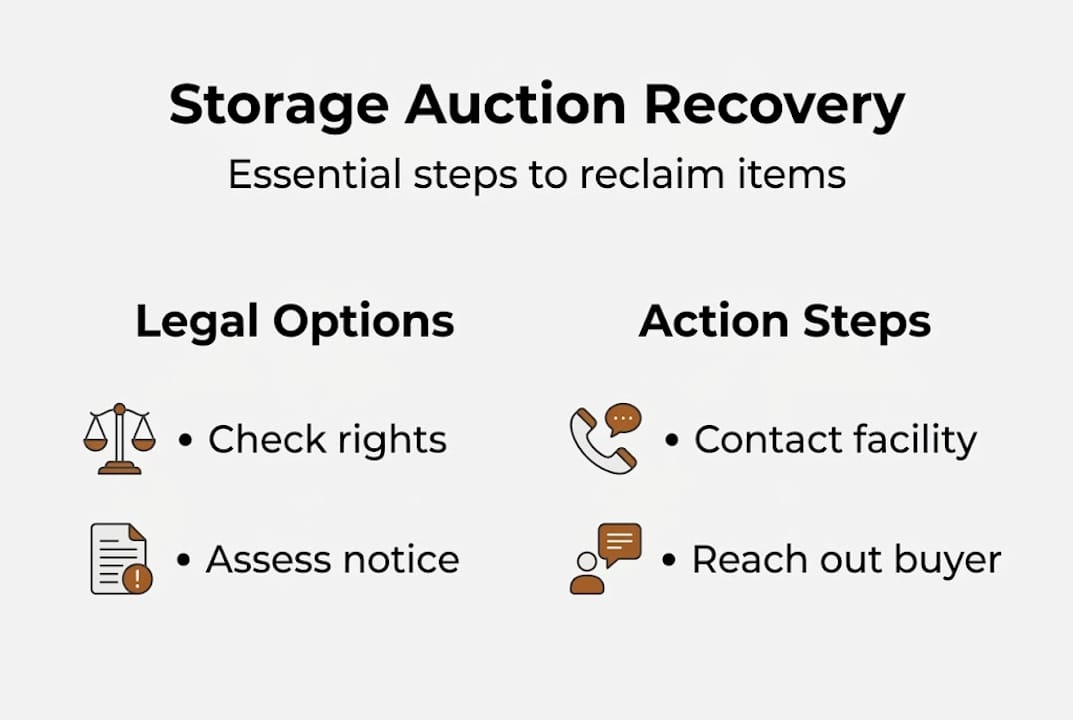
- Contact the storage facility first. Call or visit in person. Ask to speak with a manager. Explain that the unit contained personal and sentimental items, and ask whether the buyer returned anything to the facility. Many facilities hold returned items for a set period.
- Ask for the buyer's contact information. Facilities often won't share this directly, but some will pass along your contact details to the buyer. Ask them to do so on your behalf.
- If you reach the buyer, be calm and direct. Explain what you're looking for and why it matters. Most storage auction buyers are not interested in keeping family photos or someone's ashes. They want resalable items.
- Offer to meet at a neutral location. Don't ask a stranger to come to your home. Suggest a public place for any exchange.
- Put everything in writing. If the buyer agrees to return something, confirm it via text or email so there's a record.
- Check online auction listings. Some buyers list unit contents online. Search for your name, your city, or specific item descriptions.
Here's a quick comparison of your two main recovery paths:
| Approach | Best for | Typical outcome |
|---|---|---|
| Contacting the facility | Returned personal items, surplus claims | Faster, more formal |
| Contacting the buyer directly | Sentimental items buyer still has | Depends on buyer's goodwill |
Pro Tip: Use a dedicated recovery platform to cast a wider net. You can recover items through services built specifically for this situation, or report a lost item so that buyers who find your belongings know where to send them.
As noted earlier, buyers are often required to return personal documents and photos to the facility, so always start there before assuming everything is gone.
Troubleshooting and special cases
Sometimes the straightforward approach hits a wall. The facility stops responding. The buyer can't be reached. Or your situation has a legal wrinkle that standard advice doesn't cover. Here's how to handle it.
If the facility is unresponsive:
- Send a formal written request via certified mail
- File a complaint with your state's self-storage association
- Contact your state's attorney general's consumer protection division
- Consult a local attorney who handles property or lien law
If the buyer is unresponsive:
- Ask the auction platform (if online) to facilitate contact
- Post on community forums or social media with item descriptions
- Browse items for recovery on platforms that catalog auctioned unit contents
For military tenants, the path is clearer. Federal law under the SCRA may have prohibited the sale entirely. If that's your situation, contact a JAG officer or a legal assistance office on your base immediately.
For high-value items with sentimental significance, small claims court is an option if you can prove the facility failed to follow proper lien procedures. The key word is prove. You'll need documentation of the notice failure, not just your word against theirs.
"Laws prioritize facility lien recovery; buyers as good faith purchasers are protected, and tenants lose rights post-sale unless procedural errors are provable."
If you believe the sale was improper, you can challenge illegal sale procedures through the courts, but understand the odds. This path takes time, money, and documentation. It's worth pursuing for truly irreplaceable items, but go in with clear eyes.
The good news is that platforms like Cut The Lock exist specifically to bridge this gap — cataloging unit contents and actively working to return memories to their owners.
A different perspective on lost storage items: Lessons learned
Most recovery guides stop at the legal steps. But there's something they rarely say out loud: the emotional cost of this process can exceed the practical one.
Chasing down a buyer who doesn't want to be found, filing paperwork with a facility that already moved on — it's exhausting. And sometimes, after all of it, the items are simply gone. That's a hard truth, and it deserves to be said plainly.
What we've seen firsthand is that many buyers want to return sentimental items. They didn't bid on someone's grief. They wanted furniture and resalable goods. When approached with respect and a clear story, a surprising number of buyers will go out of their way to help.
Sharing your story publicly — on social media, community boards, or through platforms that connect buyers and former owners — can unlock help you didn't expect. Crowd-sourced recovery is real, and it works more often than people think.
And if recovery ultimately fails, documenting your experience still has value. It creates awareness. It might help someone else. Understanding after auction outcomes can also help you process what happened and decide when it's time to stop searching and start healing.
Need more help tracking down auctioned items?
If you've worked through these steps and still feel stuck, you don't have to navigate this alone.

Cut The Lock was built for exactly this moment. We buy abandoned storage units, catalog every single item inside, and actively work to reconnect original owners with the things that matter most. From family photos to personal documents, we treat every item as if it belongs to someone who wants it back — because it usually does. You can explore our professional recovery services, check our detailed lost item guide for next steps, or go ahead and report your lost item right now. The sooner you reach out, the better your chances.
Frequently asked questions
Can I get personal items back from a storage auction buyer?
In most cases, buyers are often required to return personal items like photos and documents to the facility for return to the original owner, though enforcement varies by state and auction rules.
Do I have to pay anything to recover sentimental items?
Usually, you do not have to pay for the return of personal items, though facility policy and state law vary. Some buyers may ask for basic proof of ownership before handing anything over.
What if the sale notice was improper or I wasn't notified?
If the facility failed to follow proper notice procedures, improper notice may allow a legal challenge against the facility, though buyers who purchased in good faith are typically still protected.
Are surplus funds from an auction available to the former owner?
Yes. If the sale proceeds exceeded your debt and fees, you may be entitled to that surplus. Most states give you 1 to 2 years to file a claim, so act promptly.
Are there extra protections for military tenants?
Yes. Military tenant protections under the Servicemembers Civil Relief Act can restrict or pause lien sales during active duty. Contact a JAG officer or legal assistance office as soon as possible if this applies to you.