

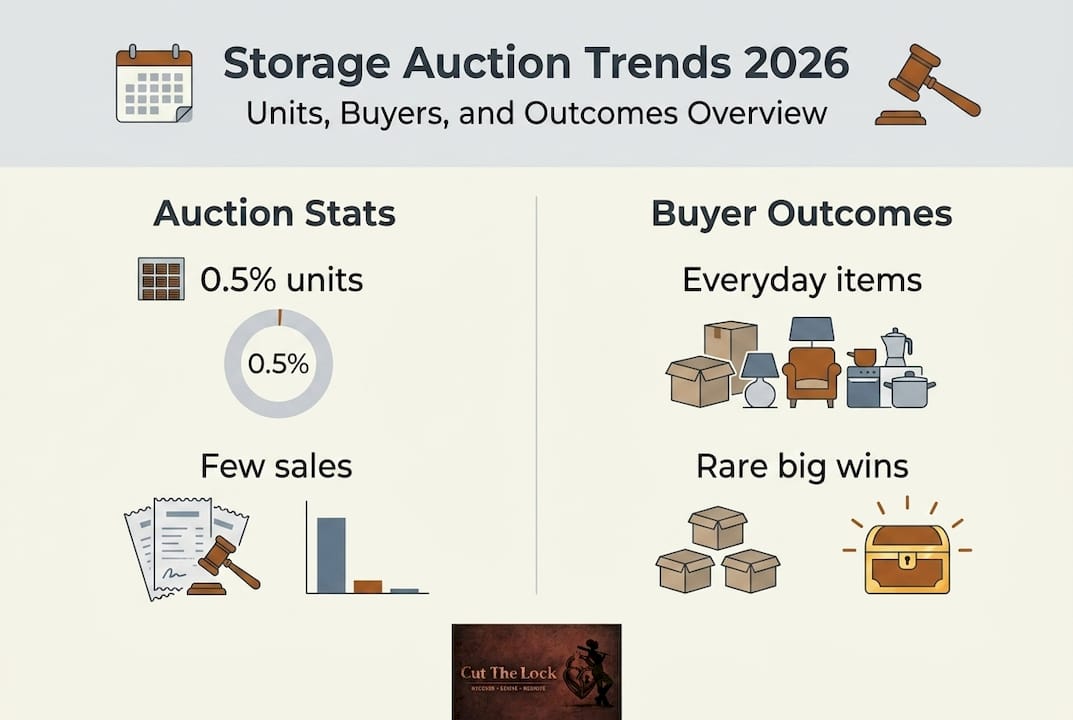
Storage auctions happen far less often than reality TV would have you believe. In fact, lien sales occur in roughly 0.5% of storage units each year, making up less than 1% of total facility revenue. If you're a buyer hunting for deals, a thrift shopper curious about sourcing, or a former tenant anxious about what's happening to your belongings, the gap between the "Storage Wars" myth and the real 2026 market is enormous. This article walks you through how storage auctions actually work, what's changing this year, and what you can do whether you're trying to win a unit or get your stuff back.
Table of Contents
- Understanding the storage auction process in 2026
- Recent trends shaping the 2026 storage auction landscape
- Buyer strategies for maximizing success in 2026 auctions
- Advice for former tenants: What to do if your unit is auctioned
- A closer look: Why storage auctions in 2026 aren't what you think
- How Cut The Lock can help buyers and former tenants
- Frequently asked questions
Key Takeaways
| Point | Details |
|---|---|
| Auctions are rare | Only about 0.5% of storage units are auctioned each year, so opportunities are limited. |
| Most auctions yield modest returns | Storage auctions rarely contain hidden riches and usually involve straightforward, administrative sales. |
| Quick action is crucial for former tenants | Once an auction is scheduled, former tenants have limited time to reclaim or track down items. |
| Online formats are growing | More storage auctions are taking place online in 2026, making access broader but competition higher. |
Understanding the storage auction process in 2026
Now that we know auctions are less frequent than most people imagine, let's break down exactly how storage auctions function in 2026.
The process starts with an unpaid storage bill. When a tenant falls behind on rent, most states require facilities to follow a formal lien process before they can sell anything. A lien is essentially a legal claim against property held as collateral for a debt. The facility must send written notices, wait a legally specified period (often 30 to 60 days), and in many states publish a public notice in a newspaper or online before a unit can go to auction. Only after all those steps are satisfied can a facility sell the contents.
Here's a simplified look at the typical 2026 storage auction timeline:
- Default on rent usually by 30 days past due
- Formal lien notice sent to the tenant via certified mail
- Waiting period mandated by state law (varies from 14 to 90 days depending on location)
- Public notice published in a local newspaper or online auction platform
- Auction held either in-person or through an online platform like StorageTreasures or Bid13
- Payment and access granted to the winning bidder, usually within 24 to 48 hours
- Unit must be cleaned out by the buyer within a facility-specified window, often 24 to 72 hours
Despite how dramatic auctions look on television, they represent a genuine last resort for storage operators. Most facilities would rather collect overdue rent than go through the legal and administrative work involved. This is exactly why lien sales account for less than 1% of total industry revenue.
"Storage auctions are not a business model. They're a last-ditch administrative measure that most facility operators actively try to avoid."
A common misconception is that storage facilities profit significantly from auctions. In most cases, proceeds barely cover unpaid rent and fees, and the facility keeps nothing beyond what's owed. The buyer, not the facility, takes on all the risk.
If you want to learn more about what happens to auctioned units once the hammer drops, the specific process may surprise you. And if you're concerned about personal items, there are real steps you can take. Understanding how to find lost items after auction is one of the most practical things a former tenant can do immediately.
Pro Tip: Use free online tools like StorageTreasures.com to find upcoming auctions in your area. Filtering by zip code lets you preview available units and review any photos posted before committing to bid.
Recent trends shaping the 2026 storage auction landscape
Understanding the process leads us to what's actually happening in the market today. Let's explore which trends are shaping the storage auction landscape in 2026.
The storage industry itself has grown considerably over the past decade, with over 50,000 self-storage facilities currently operating across the United States. Yet despite this growth, auction volume has not kept pace proportionally. The reason is straightforward: more sophisticated management software now allows facilities to catch delinquencies earlier and engage tenants in payment plans before a lien situation develops.
Here's a snapshot of how the 2026 storage auction landscape compares to previous years:
| Factor | 2022 Estimate | 2026 Estimate |
|---|---|---|
| Units auctioned annually (% of total) | ~0.6% | ~0.5% |
| Auctions held online vs. in-person | ~60% online | ~78% online |
| Average bidder participation per auction | 8 to 12 bidders | 14 to 22 bidders |
| Average winning bid (general household) | $150 to $300 | $200 to $400 |
| Former tenants successfully recovering items | Very rare | Slightly improving |
The shift to online auctions is the biggest structural change in recent years. Platforms like StorageTreasures have made it easy for buyers across the country to bid on units without physically attending. That's great for buyers who live in rural areas but it has also increased competition significantly.
Who are today's storage auction buyers? The makeup of the bidder pool has diversified considerably:
- Resellers and flippers who sell items on eBay, Facebook Marketplace, or at flea markets
- Small business owners looking for tools, equipment, or inventory
- Thrift shoppers and collectors seeking vintage goods or niche collectibles
- Curious newcomers inspired by reality TV who often exit quickly after a few losses
- Professional pickers who bid strategically on multiple units per month
One consistent finding is that most units do not yield dramatic returns. The average household unit contains everyday items: clothing, furniture, kitchen goods, and personal paperwork. Buyers who come in expecting hidden cash or rare antiques are usually disappointed. Even experienced buyers report that truly profitable units are rare finds, not the norm.
If you're a former tenant concerned about your belongings, resources for finding lost belongings can help you act quickly and understand your realistic options. The odds of recovery improve dramatically when you move fast, ideally before the buyer disposes of or resells anything.
Meanwhile, lien sales remain a minor fraction of storage industry activity, confirming that the auction "gold rush" narrative is more fiction than fact in 2026.
Buyer strategies for maximizing success in 2026 auctions
With the major trends in mind, let's turn to practical strategies for auction buyers looking to make the most of opportunities in 2026.
New buyers often walk into their first auction with vague optimism and walk away with a unit full of broken furniture and damaged goods. The buyers who succeed long-term follow specific, repeatable habits. Here's a step-by-step approach that works in 2026:
-
Register on auction platforms early. Sign up for StorageTreasures, Bid13, or your state's regional platforms well before you want to bid. Some require identity verification that takes a few days.
-
Set a hard maximum bid before you look. Decide on your maximum before you see the unit, not after you've emotionally invested in what might be inside. A good starting rule is to cap your bid at 20% to 30% of what you believe the visible items are worth.
-
Study the photos carefully. Online auctions post photos taken inside the unit door. Train yourself to spot brand names, estimate quantity of boxes, and assess condition. Cardboard boxes that look water-stained or crushed often signal damaged contents.
-
Factor in cleanup costs. Every unit requires time to clear out. If a unit is full of bulk items or broken goods, the dumpster fees alone can easily run $100 to $300. That's profit you don't have.
-
Attend in-person previews when available. Some facilities still offer a brief look-inside period. Take it. Even a 30-second glance at the floor, ceiling, and side walls tells you a lot about water damage, pest presence, and the quality of items stored.
-
Track your wins and losses consistently. Professional buyers maintain a simple spreadsheet: unit cost, resale revenue, time invested, and expenses. Most beginners skip this step and have no idea whether they're actually profitable.
-
Know what you're legally taking on. The buyer is responsible for everything in the unit. Personal documents, financial records, and sentimental items all become your responsibility once you win. Many states have rules about how you handle certain documents and ID-bearing materials.
Pro Tip: Keep an eye on what happens after an auction from the buyer's perspective, including any rules around disposing of personal documents or returning clearly irreplaceable items. Doing the right thing also protects you legally.
It's also worth remembering that lien sales affect roughly 0.5% of units annually. This rarity means that in smaller cities or rural areas, months can pass between available auctions. Building a pipeline of opportunities across multiple platforms and counties is essential for buyers who want consistent access to units.
Managing your expectations is genuinely the most important skill you'll develop. The buyers who last more than a year in this market are the ones who accept that most units are unremarkable, and that slow, steady profits beat chasing jackpots.
Advice for former tenants: What to do if your unit is auctioned
Finally, let's address a group with unique needs: former storage unit tenants whose belongings might soon be, or have recently been, auctioned.
Losing a storage unit to auction is one of the most disorienting experiences a person can go through. The items in that unit may represent years of accumulated life, including furniture, documents, photographs, and objects with zero monetary value but enormous personal meaning. Knowing your rights and acting quickly can make a real difference.
Before the auction happens:
- Contact the facility immediately. Many operators will work out a payment plan if you reach out before the auction is scheduled.
- Ask for an itemized statement of what you owe, including any late fees. Errors in billing happen and you have the right to dispute them.
- Check your state's lien law timeline. In many states, you have a right to pay off the debt right up until the auction begins.
- Request the specific auction date in writing. Facilities are usually required to notify you, but confirming the exact schedule gives you a clear deadline.
After the auction has occurred:
- Contact the facility and ask whether the unit has been sold and, if so, whether the buyer has cleared it yet. There's sometimes a window.
- Ask if the buyer left behind any paperwork, photographs, or items that were not valuable enough to resell. Some buyers voluntarily return sentimental items.
- Check online resale platforms. Buyers often post items for sale within days. Recognizing your own belongings gives you a starting point for a conversation.
- Consider reaching out to services that specialize in tracking down auctioned personal property.
Former tenants can recover items through targeted effort, but the window is often narrow. Acting within the first week after an auction is sold is almost always better than waiting.
Pro Tip: Familiarize yourself with your state's specific rules. For example, understanding Texas storage auction laws as a renter clarifies exactly what rights you have and what timeline applies to your situation.
While lien sales affect only about 0.5% of units each year, for the people inside that 0.5%, it can feel catastrophic. The legal framework exists to protect you, but only if you know how to use it and act before the window closes entirely.
A closer look: Why storage auctions in 2026 aren't what you think
Here's the thing most people miss: the "treasure hunting" framing of storage auctions actively harms both buyers and former tenants.
Buyers come in with inflated expectations, overbid on units, and lose money. Former tenants assume their belongings are gone forever and give up too soon. Both groups are operating on the same bad mythology, just from opposite sides.
The reality is that storage auctions are rare events, representing about 0.5% of units annually and less than 1% of facility revenue. Most units that go to auction contain ordinary household goods, not hidden valuables. Experienced auction buyers know this, which is exactly why they bid conservatively and treat each unit as a calculated risk rather than a lottery ticket.
The media's "Storage Wars" version of events skips past the administrative burden, the cleanup costs, the legal responsibilities, and most importantly, the human story behind every unit. There's a person behind every abandoned space and, in many cases, that person is actively looking for a way to recover something irreplaceable.
The real outcomes for lost items are more nuanced than television suggests. Some belongings make it back to their original owners. Some don't. But the chance of recovery is far higher when buyers and former tenants both understand the actual process rather than the dramatized version.
How Cut The Lock can help buyers and former tenants
If you want guidance, support, or to explore auction opportunities, here are targeted ways Cut The Lock can help.
Cut The Lock was built on a belief that losing a storage unit doesn't have to mean losing everything that mattered inside it. We buy abandoned storage units, catalog every item we find, and actively work to recover lost auction items for original owners before reselling anything else.

Whether you're a former tenant who needs to get your stuff back, or a buyer looking for fairly priced items with full transparency, we offer a different kind of marketplace. Every item in our browse available auction items catalog comes from a unit we've personally processed. You're not bidding blindly. You're shopping with context, with conscience, and with the knowledge that someone else's irreplaceable things have already been separated from the resale pile.
Frequently asked questions
How common are storage auctions in 2026?
Storage auctions are genuinely rare, with only about 0.5% of storage units going to auction each year, accounting for less than 1% of total facility revenue. Most storage operators actively prefer to collect overdue rent rather than go through the lien and auction process.
What typically happens to items auctioned from storage units?
Once a unit is auctioned, the winning buyer takes ownership of all contents and is responsible for removing everything within the facility's required timeframe. Former tenants rarely recover belongings after this point unless they move quickly to contact the buyer or a recovery service.
Can former tenants reclaim items after a storage auction?
Recovery is sometimes possible, especially sentimental or non-resalable items that buyers may voluntarily return, but fast action is essential. Once a buyer resells or disposes of items, the window closes, and recovery becomes nearly impossible.
Are most storage auctions held online or in-person in 2026?
Online auctions now represent an estimated 78% of all storage auctions in 2026, driven by platforms like StorageTreasures and Bid13. In-person auctions still occur, particularly at smaller facilities or in regions with less internet access, but the trend is firmly toward online formats and that shift is accelerating.