

Imagine coming home from a military deployment to find that everything you left in storage, the baby photos, your grandmother's jewelry, even your spouse's ashes, was sold off at auction while you were overseas serving your country. This is not a hypothetical. It happened to a real family, and their story is one of thousands that never make the news. Storage auctions are often framed as quirky treasure hunts, but for the families on the other side of that padlock, they represent one of the most disorienting and painful losses imaginable. This guide walks you through how these auctions work, what rights you have, and what you can actually do to get your belongings back.
Table of Contents
- How storage auctions happen: The process and the legal landscape
- The emotional and relational toll: What families really lose
- Edge cases and common pitfalls: When the system fails families
- What families can do: Recovery, rights, and steps after an auction
- Why the real impact of storage auctions goes deeper than dollars
- How Cut The Lock can help families recover lost items
- Frequently asked questions
Key Takeaways
| Point | Details |
|---|---|
| Notice is critical | Multiple legal notices are required before a storage auction, but communication failures often occur. |
| Emotional losses dominate | The deepest damage comes from losing family memories, photos, and irreplaceable heirlooms. |
| Legal remedies are limited | Tenants rarely win lawsuits even if auctions proceed unlawfully, due to strict contracts and deadlines. |
| Act immediately | Quick action upon receiving notice can secure vital items or improve chances of recovery after an auction. |
| Help is available | Platforms like Cut The Lock offer specialized help for families hoping to reclaim lost storage items. |
How storage auctions happen: The process and the legal landscape
Storage auctions do not appear out of nowhere. They follow a legal chain of events governed by state lien laws, and understanding that chain is the first step to knowing where things can go wrong.
When a tenant stops paying rent, the clock starts ticking. Storage auctions occur after 30 to 90 days of unpaid rent, and the process is driven by state-specific lien laws that require facilities to send multiple notices before selling anything. The idea is that you get fair warning. In practice, the system is more fragile than it sounds.
Here is what the notice process is supposed to look like:
- Certified mail notice sent to your address on file
- Email notice if an address was provided at move-in
- Public advertisement in a local newspaper or online auction platform
- Final grace period before the auction date
The problem is that each step depends on your contact information being current. If you moved, changed your phone number, or simply did not check your email, you may miss every single notice without the facility technically violating the law.
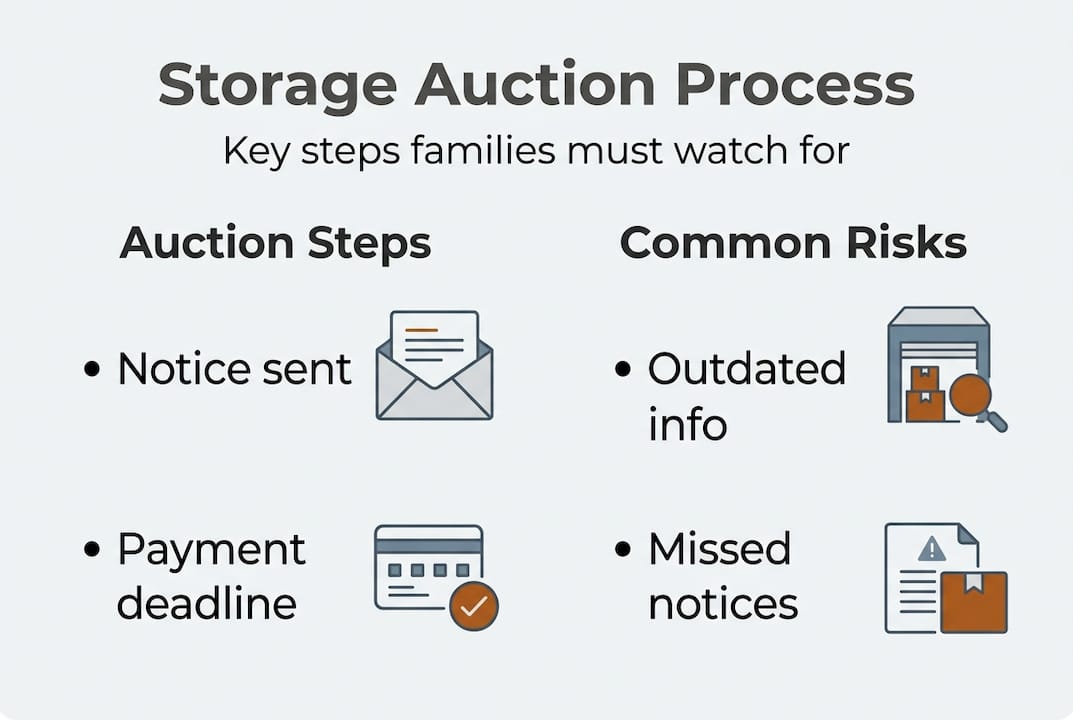
Here is a quick look at how key legal elements compare across the process:
| Stage | What should happen | Where it breaks down |
|---|---|---|
| Notice sent | Certified mail + email | Outdated contact info |
| Public ad | Posted 10-14 days before sale | Buried in small print |
| Auction day | Unit sold to highest bidder | Proceeds rarely returned |
| Surplus funds | Legally owed to original tenant | Rarely claimed or paid |
One important detail most people miss: if the auction generates more money than you owe in back rent and fees, that surplus legally belongs to you. Many tenants never know to claim it. Understanding what happens at a storage auction before you face one gives you a real advantage.
The emotional and relational toll: What families really lose
The financial loss from a storage auction is real. But it is rarely the part that keeps families up at night.
Families lose irreplaceable sentimental items like family photos, childhood albums, military heirlooms, and even the ashes of deceased loved ones. These are not things you can replace with insurance money or a shopping trip. They are gone, often forever, and the grief that follows mirrors the grief of losing someone.
Here is what families most commonly report losing to auctions:
- Urns and cremated remains of parents, spouses, or children
- Photo albums spanning decades of family history
- Military medals, uniforms, and service records
- Children's artwork, report cards, and baby keepsakes
- Handwritten letters and family documents
"It felt like losing them all over again." This is how one family described the moment they learned their loved one's ashes had been auctioned off with the rest of their belongings. The quote is not unusual. It is, tragically, representative.
The emotional damage does not stop with the individual who lost the items. Families fracture over storage auctions in ways that outsiders rarely see. One sibling may have been responsible for the payments. Another may have stored items there on trust. When the unit goes, so does the goodwill.
Shows like Storage Wars have monetized personal distress by framing auctions as exciting treasure hunts, which effectively sanitizes the human cost of what is happening. Every "score" a buyer celebrates on camera was once someone's life, stored away during a divorce, a hospitalization, or a financial crisis. The entertainment framing makes it harder for the public to take the real harm seriously.
If you are searching for items that may have gone through an auction, you can find lost sentimental items through platforms built specifically to reconnect families with their belongings.
Edge cases and common pitfalls: When the system fails families
Even families who do everything right sometimes lose their belongings. The auction system has enough gaps that mistakes happen with real, permanent consequences.
Premature auctions and disposals without notice are more common than the industry admits. Items including medical devices and cremated remains have been sold or discarded before tenants had any reasonable opportunity to respond. And when families try to fight back legally, they face steep odds: plaintiffs lose roughly 80% of these cases, often because storage contracts contain broad language that shields facilities from liability.
Here is a comparison of the legal landscape for different types of tenants:
| Tenant type | Legal protections | Real-world outcomes |
|---|---|---|
| General tenant | State lien law notices | Often insufficient; easy to miss |
| Military (active duty) | SCRA protections require court order | Not always honored by facilities |
| Tenant mid-payment | May have evidence of good faith | Rarely enough to stop sale |
| Tenant with medical items | Some states allow document retrieval | Limited and inconsistently applied |
The accidental sale of wrong units due to mix-ups or restoration company errors is a documented problem. Number transpositions, unit reassignments after move-outs, and contractor mistakes have all led to auctions of units that should have been completely off-limits.
Pro Tip: If you suspect your unit was sold in error, document everything immediately. Take screenshots, save voicemails, and write down every conversation with dates. You will need this if you pursue illegal storage sales lawsuits or file a formal complaint.

Knowing how to recover items lost in auction starts with acting fast and building a paper trail from day one.
What families can do: Recovery, rights, and steps after an auction
Speed matters more than almost anything else after a storage auction. The window for recovery, legally and practically, closes fast.
Here is a step-by-step approach for families navigating this situation:
- Confirm the exact auction date and applicable deadlines. State statutes of limitations vary. Some give you months; others give you weeks.
- Request pre-auction access if you are still within the notice period. Some states, including Minnesota, allow limited retrieval of documents and medical items before the sale goes through.
- Contact the facility in writing immediately. Ask for a complete record of all notices sent, the auction buyer's information if available, and any surplus funds owed to you.
- Report your lost sentimental or essential items through recovery channels designed for this purpose. The sooner you file, the better the odds.
- Document every communication. Emails, calls, letters. Keep a log with timestamps. This becomes your evidence if legal action is warranted.
- Reach out to platforms that specialize in reuniting families with lost storage items. These services catalog purchased units and actively work to return personal belongings.
Pro Tip: When you report lost storage items, include photos if you have them, detailed descriptions, and any identifying marks. The more specific you are, the easier it is for recovery teams to match your belongings.
Understanding the storage auction legal process and your state's specific rules gives you the clearest picture of what options are still available to you. You can also browse resources on how to find lost items after a storage auction to understand what the recovery process actually looks like.
Why the real impact of storage auctions goes deeper than dollars
The storage industry often describes auctions as a rare last resort, a reluctant business necessity that affects only a tiny fraction of renters. And technically, that framing is not wrong. But it misses the point entirely.
Storage auctions are almost always a symptom of something bigger. Divorce. Job loss. A medical emergency that wiped out savings. Deployment. A death in the family that left no one to manage the bills. The industry defends these auctions as financially neutral or even unprofitable for facilities, but the true cost is never financial. It lands on families already in crisis.
What bothers us most is not that the auctions happen. It is that the system treats the loss of someone's mother's ashes with the same legal indifference as the loss of an old couch. There is no distinction in the law between a box of tax documents and a box containing someone's entire family history. Both get sold for the same price.
Real reform would require storage facilities to implement better safeguards for sentimental or irreplaceable items, not just better notice procedures. It would require media to stop treating these losses as entertainment. And it would require more platforms committed to connecting families after auctions with what they lost.
Families deserve better than a system that treats their worst day as someone else's bargain.
How Cut The Lock can help families recover lost items
If a storage auction has taken something irreplaceable from your family, you do not have to accept that it is gone forever.
Cut The Lock buys abandoned storage units, catalogs every single item inside, and actively works to return personal belongings to their original owners. When you recover items after an auction through Cut The Lock, you are working with a team that understands what these things mean, not just what they are worth. Browse available recovered items and find lost belongings that may have passed through our hands. Or take the first step right now and report lost auction items so our team knows exactly what to watch for. One person's worst day does not have to be permanent.
Frequently asked questions
How long before a storage unit is auctioned for unpaid rent?
Most states allow auctions after 30 to 90 days of nonpayment, following required legal notices including certified mail and public advertisement.
Is it possible to recover sentimental items after a storage auction?
Recovery is possible if the buyer cooperates or the item appears on a recovery platform, but most items are irretrievable once sold, making speed and documentation critical.
What legal remedies are available if a storage auction did not follow protocol?
You may sue for wrongful sale, but plaintiffs lose roughly 80% of these cases due to broad contract language and short filing deadlines.
How can military families protect their belongings in storage?
Active-duty military are protected under the SCRA, which typically requires a court order before a facility can auction a unit, though this protection is not always enforced.
Recommended
- Lost Items in Storage Auction? We Can Help | Cut The Lock
- Lost Items Storage Auction — How to Find Your Belongings | Cut The Lock
- What Happens to Your Stuff When a Storage Unit is Auctioned? | Cut The Lock
- 5 Ways to Find Lost Items After a Storage Auction in Texas | Cut The Lock
- 7 creative ways to use animated memories with your kids — WonderLens | WonderLens
- Storage solutions in moving: your 2026 family guide