

Most people who walk into their first storage unit auction assume it works like a garage sale. Pick what you want, make an offer, walk away with a box of vintage records. That is not even close to how it works. Storage auctions are tightly regulated legal proceedings governed by state lien laws, strict timelines, and terminology that can confuse even experienced bidders. Whether you are hunting for deals, searching for lost belongings, or just trying to understand what happened to your unit, knowing the language before you show up is the difference between a smart bid and a costly mistake.
Table of Contents
- Decoding key storage auction terms
- Legal requirements and timeline for auction
- Auction formats: In-person vs. online
- Insider tips for finding lost items and maximizing auction value
- Why most auction newcomers misunderstand storage unit rules
- Next steps: Recovering lost items and bidding with confidence
- Frequently asked questions
Key Takeaways
| Point | Details |
|---|---|
| Understand auction terminology | Key phrases like 'lien sale' and 'as is, where is' determine your rights and risks as a bidder or former tenant. |
| Track legal timelines | Auction timelines and notice periods vary state by state and can impact whether you recover your belongings or bid successfully. |
| Choose the right auction format | Online auctions offer convenience, while in-person events allow for a more sensory inspection—each affects how you strategize. |
| Maximize value with insider tips | Smart bidders use well-defined terminology and legal rules to spot valuable deals and avoid costly mistakes. |
Decoding key storage auction terms
With that preview in mind, let's break down the essential language you will encounter at any storage auction.
The term lien sale is where everything starts. A lien sale occurs after a tenant defaults on their storage payments, the facility sends required legal notices over a period typically spanning 30 to 90 days, advertises the auction publicly, and then sells the unit's contents to the highest bidder. The facility is not selling the unit itself. It is selling what is inside it, to recover unpaid rent.
Default simply means a tenant has stopped paying rent and has not resolved the balance within the facility's grace period, usually 5 to 15 days past the due date. Once that window closes, the legal clock starts ticking.
Here are a few more terms every auction participant needs to know:
- Cleanout: The winner must remove every item from the unit, often within 24 to 48 hours. Leave anything behind and you forfeit your cleaning deposit.
- Winning bid: The highest offer accepted by the auctioneer. It does not mean you own the items until full payment clears.
- Auctioneer: The licensed professional running the sale. Their call is final.
- As is, where is: Possibly the most important phrase in storage auctions. You buy everything in the unit exactly as it stands, with no returns, no warranties, and no cherry-picking.
Payment is almost always cash only, and most facilities require a cleaning deposit of $50 to $100 upfront. You get it back only after the unit is completely emptied and inspected.
| Term | Plain-language meaning |
|---|---|
| Lien sale | Legal auction triggered by unpaid rent |
| Default | Failure to pay rent within the grace period |
| As is, where is | No returns, no selections, full unit only |
| Cleanout | Mandatory complete removal of all unit contents |
| Cleaning deposit | Refundable fee to ensure full cleanout |
Pro Tip: Print out a glossary and bring it to your first auction. Auctioneers move fast, and there is no time to Google terms while bidding. You can also review the auction process overview to see how these terms play out in real situations.
Legal requirements and timeline for auction
Once you've understood the terminology, it's crucial to grasp the legal framework and timelines that govern storage auctions.

Storage auctions do not happen overnight. There is a legally defined sequence of events, and every step matters, especially if you are a former tenant trying to recover your belongings before the sale happens.
Here is how the process typically unfolds:
- Tenant stops paying rent. The grace period begins, usually 5 to 15 days.
- Grace period expires. The facility locks access and begins the default process.
- Certified notice sent. The facility mails a legal notice to the tenant's last known address.
- Waiting period begins. State law dictates how long the facility must wait before advertising the auction.
- Public advertising. The auction must be advertised, often in a local newspaper or online.
- Auction held. Bidding is open to the public.
State laws vary significantly. California, for example, requires certified mail notice plus a minimum 14-day waiting period after notice is delivered. Other states allow 30 to 60 days post-default before auction. All states require the process to be commercially reasonable, meaning a facility cannot sell a unit with just one bidder present and call it a fair sale.
| State example | Notice type | Minimum waiting period |
|---|---|---|
| California | Certified mail | 14 days post-notice |
| Texas | Certified mail + publication | 14 days post-notice |
| Florida | Certified mail | 30 days post-default |
| General standard | Mail and/or publication | 30 to 60 days |
One protection most people overlook: active duty military members cannot have their unit auctioned without a court order, thanks to the Servicemembers Civil Relief Act (SCRA). If you or someone you know is serving and facing a lien sale, that protection exists and should be used.
If you are in Texas, the Texas auction laws page covers state-specific rules in detail. If you think personal items from your unit may have already been sold, you can learn about finding lost auction items or go directly to the recovering lost items resource.
Pro Tip: If you receive a lien notice, start the clock immediately. Contact the facility, arrange payment, or seek legal help. Every day counts.
Auction formats: In-person vs. online
The legal groundwork sets the stage, but the format of the auction itself dramatically changes your strategy.
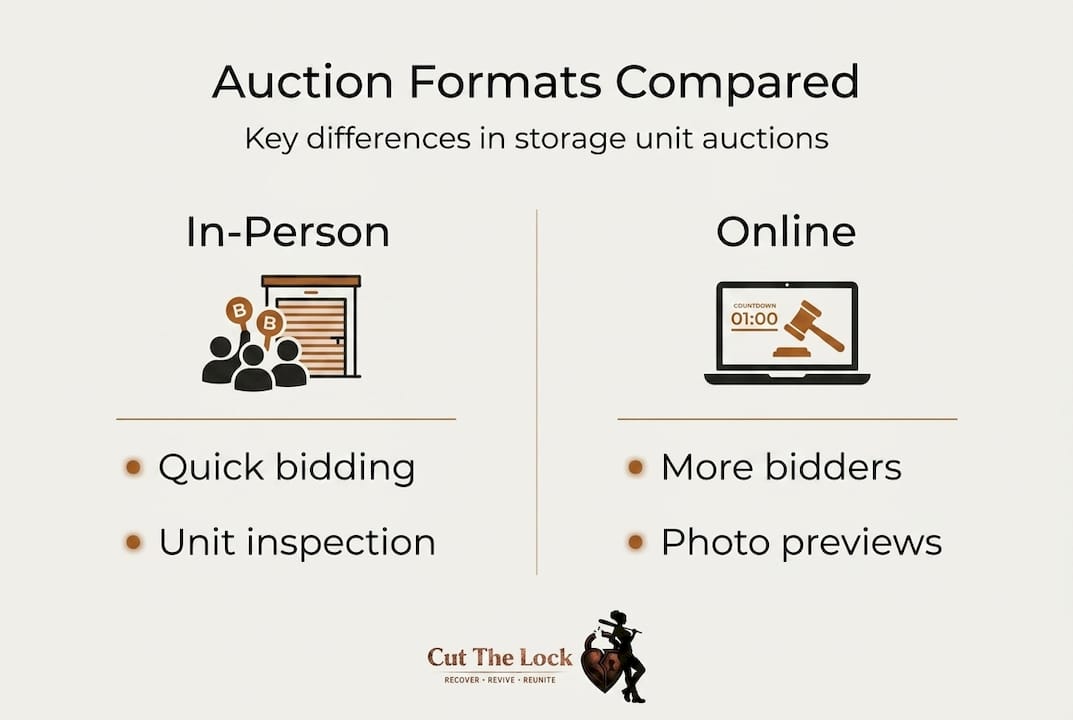
Storage auctions have always been in-person events, but that has shifted considerably. Today, a large share of auctions happen online through platforms like StorageTreasures. Both formats have real advantages and real limitations.
"Online auctions have become increasingly common, but in-person events still offer one advantage no photo can replicate: the ability to smell for mold."
That detail is not a joke. Experienced buyers walk up to a unit door and take one sniff. Mold means damaged goods, potential health hazards, and a cleanout nightmare. Photos online cannot tell you that.
| Feature | In-person auction | Online auction |
|---|---|---|
| Viewing | Doorway only, real-time | Photos and video only |
| Bidder pool | Local attendees | National or regional |
| Mold/smell check | Yes | No |
| Payment timing | Immediate, often cash | Platform-dependent |
| Cleanout window | Usually 24 to 48 hours | Same, starts at pickup |
Here is what stays the same across both formats:
- You still buy the unit "as is, where is"
- You still cannot pick through items before winning
- You still owe the cleaning deposit
- You still face a tight cleanout deadline
Online auctions broaden the bidder pool, which can drive prices higher. In-person auctions reward quick thinking and pattern recognition. Seasoned bidders who attend in-person events often develop a feel for which facilities tend to have better-quality units based on neighborhood, unit size, and facility reputation.
If you have already won a unit and believe it may contain someone's personal items or irreplaceable belongings, get your stuff back walks through what options exist.
Insider tips for finding lost items and maximizing auction value
With a clear understanding of auction formats, you can now focus on pro-level techniques to increase your odds of finding lost treasures or maximizing your auction haul.
Whether you are a former tenant hoping to recover something precious or a bidder looking to make smart purchases, strategy matters more than luck.
For former tenants searching for lost items:
- Check online auction listings immediately. Many post photos, and you may spot your items before the auction closes.
- Contact the facility directly. If the auction has not yet happened, you may still be able to settle the debt and retrieve your belongings.
- If the auction has already occurred, use resources like find lost items after auction to understand your options.
For bidders maximizing value:
- Analyze what is visible from the doorway. Look for furniture density, labeled boxes, electronics, and any visible high-value items.
- Research comparable unit sales on auction platforms before bidding. Know your ceiling before the auctioneer opens their mouth.
- Budget for the cleaning deposit separately. Never let that $50 to $100 catch you off guard.
The phrase "as is, where is" means bidders view from the doorway only, cannot touch any items, and must pay immediately after winning, often in cash, plus a cleaning deposit typically between $50 and $100. First-time buyers often assume they can sort through boxes and decide. They cannot.
Common mistakes that cost bidders money and time:
- Underestimating cleanout time. A packed 10x20 unit can take an entire weekend.
- Overbidding based on one visible item. That flat-screen TV may be broken.
- Missing the cleanout deadline and forfeiting the deposit.
Pro Tip: Before any auction, reach out to the auctioneer or facility manager to clarify ambiguous terms in the listing. A two-minute conversation can prevent a two-day disaster. For those who want help recovering your belongings after a unit has been sold, support is available.
Why most auction newcomers misunderstand storage unit rules
The mechanics outlined above are only half the story. Here are the hard-won lessons that most auction guides overlook.
Most newcomers approach storage auctions the way they approach estate sales: arrive, browse, buy what interests you, leave. That mindset causes real problems. The "as is, where is" rule is not a formality. It is an enforceable legal condition. Bidders who expect flexibility tend to be the ones who argue with auctioneers and lose their deposits.
The second big misunderstanding is around timelines. Tenants often assume they have more time than they actually do once a lien notice arrives. They wait, thinking a phone call will pause the process. Facilities have already spent weeks following legal requirements before that notice ever reaches a mailbox.
The detail almost no one knows before they need it: the SCRA protection for active military. Facilities are not always proactive about flagging this, and tenants who qualify sometimes let their units go to auction without knowing they had legal protection all along. The real auction stories on our site include situations exactly like this.
Small legal details, like whether notice was sent by certified mail versus publication only, or whether the deposit amount was disclosed in the listing, can completely change the outcome for both bidders and tenants. Read everything before you commit to anything.
Next steps: Recovering lost items and bidding with confidence
Now that you're equipped with terminology and insider knowledge, here's how Cut The Lock can support your next auction or lost item search.
Cut The Lock was built for exactly the situations this article describes. Whether you are a former tenant who lost something irreplaceable when a unit was auctioned, or a bidder looking for curated inventory with real transparency, there is a path forward.

If you are searching for a lost item, start with the lost item finder to see if your belongings have been cataloged. If you have already identified something, you can report lost item directly and we will work to reunite you with it. For bidders, the auction listings page shows available inventory with more transparency than a standard lien sale. No surprises. No guessing.
Frequently asked questions
What does 'lien sale' mean in storage unit auctions?
A lien sale is when a storage facility sells the contents of a unit due to unpaid rent after legal notice and advertising requirements are fully met. The facility uses the proceeds to recover the debt owed.
How much time does a tenant have before their unit is auctioned?
Tenants generally have between 14 and 90 days after default, depending on state law, before their unit can be sold. State laws vary widely, so checking your local rules as soon as you receive any notice is critical.
Can active military members lose their storage unit at auction?
No. Federal law under the SCRA protects active duty military members from lien sales without a court order. This protection applies regardless of the facility's standard auction timeline.
What does 'as is, where is' mean for auctioned storage units?
"As is, where is" means you buy the unit exactly as it appears with no guarantees, no item selection, and no returns. Bidders view from the doorway only and cannot touch items before winning.
How do online storage unit auctions differ from in-person events?
Online auctions allow remote bidding through platforms like StorageTreasures but limit physical access to photos and videos. In-person auctions allow direct viewing and even smell tests for mold, giving experienced bidders an edge that no image can provide.